
Newsroom

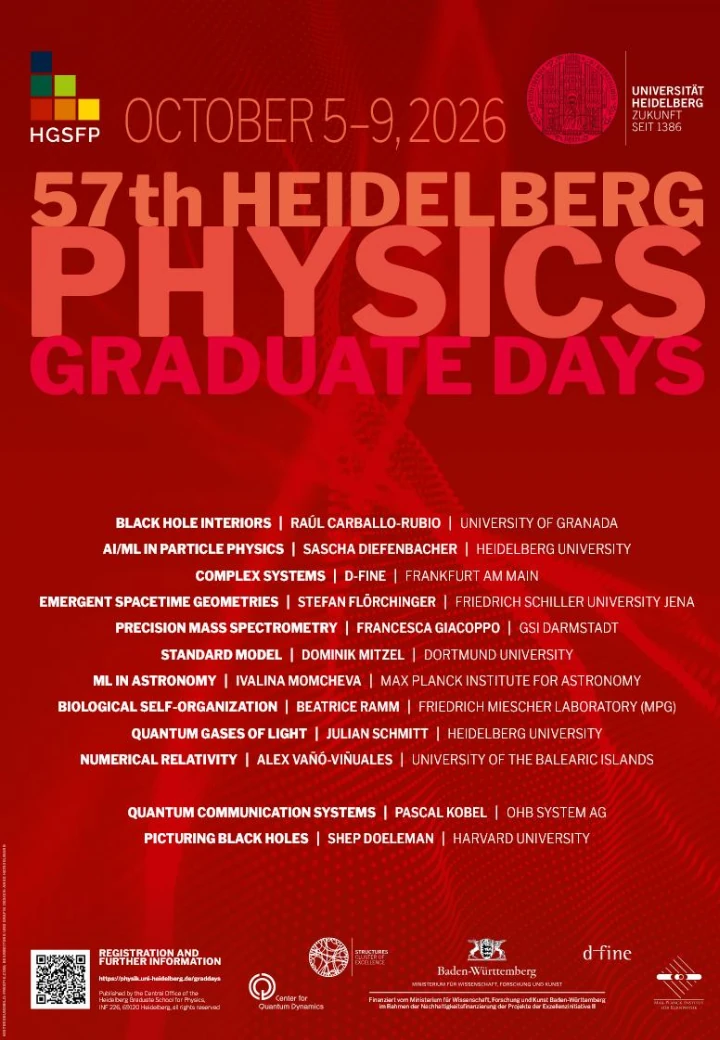
From 5–9 October 2026, the 57th Heidelberg Physics Graduate Days will once again bring together doctoral researchers of the Department of Physics and Astronomy at Heidelberg University. The event, which takes place biannually and is supported by the STRUCTURES Cluster of Excellence, offers advanced students and researchers a biannual spring/autumn school featuring different topics from various fields of physics.
The Physics Graduate Days reflect the breadth of modern physics and its interdisciplinary perspectives – from artificial intelligence (AI) in particle physics to quantum communication systems, from emergent spacetime to biological self-organization, and from quantum gases to black holes. The courses offer insights beyond the standard curriculum and highlight connections with scientific computing, mathematics and numerical methods, biology, and technological applications.
This year's speakers are Sascha Diefenbacher, Raúl Carballo-Rubio, Ivelina Momcheva, Stefan Floerchinger, Dominik Mitzel, Francesca Giacoppo, Julian Schmitt, Alex Vañó Viñuales, Beatrice Ramm, Pascal Kobel, Shep Doeleman, and the d-fine Team.
A special highlight of the programme will be the Hans Jensen Invited Lecture by Shep Doeleman (Harvard) on Taking Pictures and Making Movies of Supermassive Black Holes. Moreover, as a special event, this year's Graduate Days will host the Wilhelm und Else Heraeus-Stiftung Symposium and Award Ceremony for outstanding PhD theses!
The courses are open to advanced students, in particular those working on their Master's and doctoral theses. Our aim is to offer courses that broaden the physics knowledge of our students as well as to teach specialized techniques. The courses are organized as parallel block lectures, with the morning lectures taking place from 9:30 to 12:30 and the afternoon lectures from 14:00 to 17:00, including coffee breaks. There is also a free lunch each day included in your registration. Note that each course runs every day for four days, either in a morning or afternoon slot.
The Scientific Advisory Team consists of Dr. Sanam Vardag, Tristan Bereau, Astrid Eichhorn, Annalisa Pillepich, Eduard Thommes, Rainer Stamen, Werner Rodejohann, Björn Malte Schäfer, Louis Jussios and Jonathan Steiner.
Further information: