
Newsroom

Quantum Gases of Light Exhibit Critical Scaling Behaviour – Major Research Gap in the Physics of Phase Transitions Closed
An international team of researchers including STRUCTURES member Julian Schmitt has studied the critical behaviour of photons close to a phase transition. The researchers have demonstrated the phenomenon of critical scaling behaviour in a quantum gas of photons for the first time. The result has been published in Science Advances.
A team of researchers from the University of Bonn, Heidelberg University and the National Autonomous University of Mexico has studied the critical behaviour of light particles (photons) close to a phase transition. This critical scaling behaviour, which sees thermodynamic quantities grow extremely large or diverge near phase transitions, had never before been seen in photon gases until the researchers successfully secured precisely this proof. They measured spatial correlations, i.e. how strongly the state of the light at different positions is related, in a nearly non-interacting 2D photon gas trapped in a mirror box just before the Bose-Einstein condensation phase transition. From this, they determined the critical exponent – a quantity describing how sensitively the spatial extent of these correlations increases as the temperature changes near the phase transition.
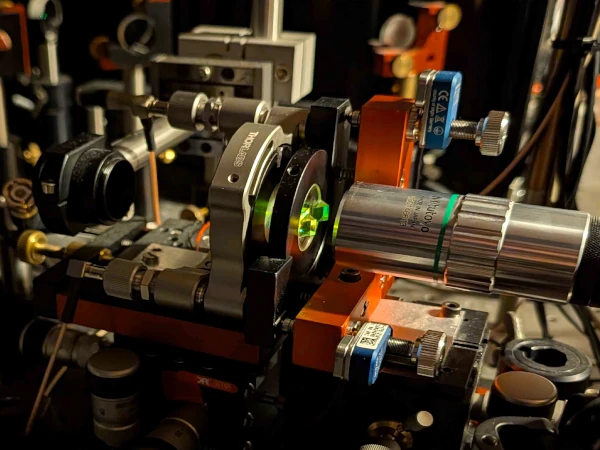
They trapped light particles inside an optical microresonator – a microscopic cavity formed by two closely spaced mirrors – filled with a dye solution. Through processes of absorption and emission as the light particles came into contact with the dye molecules, the photons effectively cooled down (“thermalised”) to a point where the quantum phase of condensation began. One of the resonator mirrors had been structured at the nanometre scale beforehand by means of laser writing to create a box-like potential, i.e. a trap for the photons. The angular distribution of the light emitted was then measured with a camera and analyzed via Fourier transform to determine the spatial correlations.
This was the first-ever experiment that demonstrated that photon gases constitute a distinct, overarching universality class of physical systems in nature, meaning that they follow characteristic laws near a phase transition. Much like water, which at the critical point suddenly turns cloudy due to opalescence (i.e. increasingly large density fluctuations scatter light), the photon gas in this case exhibits a rapidly increasing and diverging correlation length with a specific exponent. This research finding thus fills a key gap in the physics of phase transitions and has the potential to open up exciting new avenues for basic research into systems that lie well outside thermal equilibrium as well as for future applications in optics.
The team consists of researchers from the Institute of Applied Physics at the University of Bonn (Leon Kleebank, Frank Vewinger, Martin Weitz), the Kirchhoff Institute for Physics at Heidelberg University (Julian Schmitt) and the Physics Institute at the National Autonomous University of Mexico (Arturo Camacho-Guardian, Victor Romero-Rochín, Rosario Paredes). The project was led by Professor Julian Schmitt (Heidelberg).
This text was adapted from the original press release by the University of Bonn.
Further information: