
Newsroom
Stay informed with our latest news and announcements on this page. For more in-depth content, we also encourage visitors to explore our bimonthly STRUCTURES Newsletter magazine, which features a variety of articles, interviews with members, and background information on our latest research and activities.

We are delighted to announce the next event in our Machine Learning Galore! series, focusing on Scientific Machine Learning, which will take place on Thursday, November 13, from 4:30 to 6:00 pm at INF 205 Mathematikon (5th floor). The event features lab presentations by principal investigators, followed by brief presentations from junior scientists showcasing their latest work. Extended discussions will offer ample opportunity for in-depth exchanges.
Event Details:
- Lab presentations:
- Lukas Balles
- Jürgen Hesser
- Wolfgang Huber
- Science Talks:
- Constantin Ahlmann-Eltze (Huber lab): ML in Single Cell and Spatial Omics for Tissue Biology and Biomedical Research
- Pit Neitemeier (Balles lab): Learnt splitting and the influence of compression ratios in end-to-end hierarchical language modeling
- Marcus Buchwald (Hesser lab): Reaching for Causal Image Generation using deep conditioning
Registration is free but required via the ML-AI portal:
https://www.mlai.uni-heidelberg.de/en/machine-learning-talks-on-campus
About Scientific Machine Learning
Scientific Machine Learning is a collaborative initiative by the Interdisciplinary Center for Scientific Computing (IWR) and the STRUCTURES Cluster of Excellence. Its mission is to foster interaction and exchange within the local machine learning community, and to support its development by consolidating activities and resources that might otherwise remain scattered across individual institutions or disciplines. The initiative aligns closely with the objectives of STRUCTURES, which aims to advance fundamental research, and with IWR’s focus on applying machine learning to address long-standing challenges in the natural and life sciences, engineering, and the humanities.
Further information:

ENUMATH: International Conference Brings Together 600 Numerical Mathematicians in Heidelberg


From September 1 to 5, 2025, Heidelberg University welcomed the international numerical mathematics community to the Neuenheimer Feld campus for 2025's European Conference on Numerical Mathematics and Advanced Applications (ENUMATH). The event, supported by the STRUCTURES Cluster of Excellence, brought together more than 750 participants from over 30 countries and six continents, including leading experts as well as early-career researchers. Over the course of five days, mathematicians and computational scientists from all backgrounds shared their latest results, exchanged ideas, and explored new directions for applying numerical mathematics in science and industry.
Alongside invited plenary lectures by leading international experts, the scientific program consisted of over 600 talks in mini-symposia and contributed sessions, as well as a large poster session. Vibrant discussions spanned from advances in discretization schemes and multi-scale modelling to questions on uncertainty quantification, optimisation, and scientific machine learning – reflecting the broad scope and growing role of numerical mathematics in solving complex scientific and industrial challenges.
This year's conference was chaired by STRUCTURES member Robert Scheichl. The local organization committee included Peter Bastian, Roland Herzog, Vincent Heuveline, Guido Kanschat, Ekaterina Kostina, and Jakob Zech – members of STRUCTURES, IWR and IMa. The Programme Committee consisted of nine international experts from various countries across Europe. Their efforts, supported by numerous colleagues, institutions, and partners, made the conference a big success.
Since its launch in 1995, ENUMATH has established itself as a central forum for the exchange of ideas in numerical mathematics. The Heidelberg meeting continued this tradition by fostering international collaboration and providing a platform for early-career researchers to present their work alongside established experts. Proceedings of the conference will appear with Springer, extending the impact of the lively discussions in Heidelberg to the wider mathematical community.
For STRUCTURES, supporting ENUMATH was a way of underlining the importance of numerical mathematics for our mission to connect disciplines and methods across the natural sciences. It was a great pleasure to welcome the international numerical mathematics community to Heidelberg, a vibrant hub for mathematics and computational science in Europe.
Further information:

We are pleased to announce that our member Victor Ksoll will establish a new research group at the Institute of Theoretical Astrophysics (ITA), one of the participating institutes in STRUCTURES, starting in early 2026. Supported by funding from the Carl Zeiss Foundation, the group – titled “Machine Learning Solutions for Star Formation” (StarForML) – will develop innovative machine learning algorithms for the efficient analysis of astrophysical observational data.
The group’s research will focus in particular on star formation, a complex process spanning a vast range of sclaes from molecular clouds to individual protostars. Comparing theoretical predictions to observations requires solving so-called inverse problems, which are computationally intensive. Given the massive data volumes produced by modern telescopes, machine learning has become an indispensable tool for tackling this challenge in an automated fashion. Dr. Ksoll’s goal is to design machine learning methods for such inverse problems in astronomy to enhance our understanding of star formation while increasing the transparency and interpretability of these computational approaches. The group will also employ transfer learning techniques to bridge the gap between simulations and real observational data.
About Victor Ksoll
Victor Ksoll studied physics at the University of Heidelberg, where he also earned his doctorate in astronomy. His research included stays at the Institute of Planetology and Astrophysics in Grenoble, France, and the Space Telescope Science Institute in Baltimore, USA. Within STRUCTURES, he is involved in projects CP 1 (Cosmic Structure Formation) and CP 2 (From Dust to Planets) in addition to various Exploratory Projects. He is also a member of STRUCTURES' Young Researchers Convent (YRC).
Further information:
We are happy to announce the upcoming Heidelberg Physics Graduate Days at Heidelberg's Graduate School for Physics (HGSFP), supported by the STRUCTURES Cluster of Excellence. The courses take place from October 6 to 10, 2025, in the form of parallel block lectures in the mornings and afternoons.
The Heidelberg Physics Graduate Days, which take place biannually, serve as a dynamic platform for advanced students and researchers to broaden their perspective in physics by attending introductory courses on topics that are unfamiliar to them, or deepen their knowledge by attending specific courses that may be offered at a deeper level.
In addition to the block courses, the Department for Physics and Astronomy cordially invites interested participants and guests to the Hans Jensen Invited Lecture, which will be given by Mark Thomson on “Particle Physics: Today and Tomorrow” on Thursday, October 9, 2024, 17:30 at INF 308, HS1.
Further information:

Understanding complex quantum systems remains a central challenge in modern physics. These systems can display correlations, pairing, and exotic states of matter that are key to both fundamental science and future quantum technologies. Yet, many of these processes occur on spatial scales too small to be resolved even with advanced imaging techniques. In particular, while current single-atom imaging techniques are powerful, they fail once the relevant structures fall below the resolution limit of the detection method, leaving essential microscopic correlations hidden.
To overcome this fundamental limitation, Sandra Brandstetter and her colleagues from the group of STRUCTURES member Selim Jochim have developed a novel "matter-wave microscope". Before imaging the atoms, their approach first magnifies their wave function by a factor of about 50. This is achieved by precisely controlling the atoms' time evolution within specially designed optical potentials, essentially performing two “rotations” of the wave function in phase space, without disturbing the correlations that are of interest for their study.
This new technique unlocks the ability to access arbitrary higher-order correlations. Its applications extend to in-depth studies of fermionic pairing and other exotic systems; and help reveal the building blocks of future quantum technologies.
Further information:
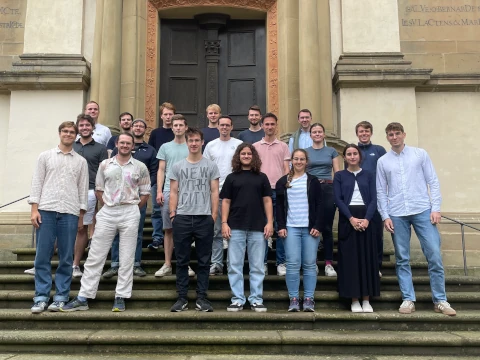
For four days in August, sixteen students and two professors gathered at the beautiful Schöntal Abbey to study and discuss about the topic of Inverse Problems. Participants were organized in four groups, each of which carefully prepared subtopics, and presented them during the workshop, leading to in-depth discussions. The Schöntal workshop was thus a lively and enriching experience!
The annual workshop, funded by STRUCTURES' Young Researchers Convent (YRC), brings together early-career researchers from different areas of STRUCTURES to engage in discussion over topics that go beyond the standard curriculum of a lecture. This year's workshop, marking its ninth edition, was organized by Rebecca Maria Kuntz, Carlos Pastor Marcos, Hannes Heisler, and Sander Hummerich.
Further information:
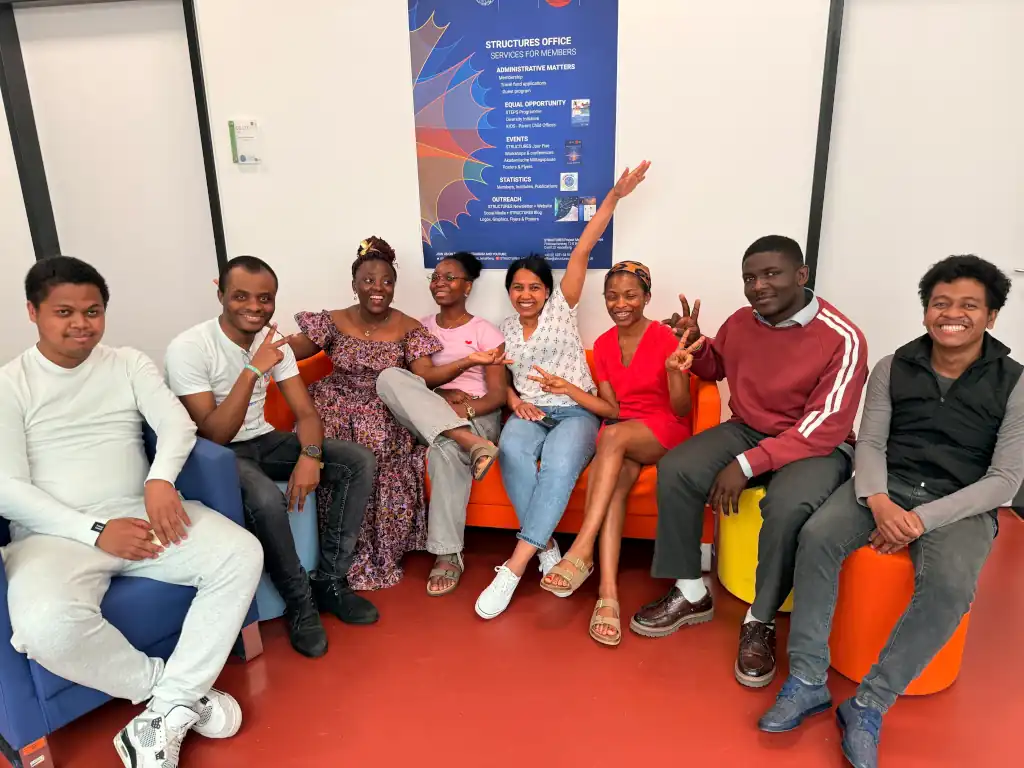
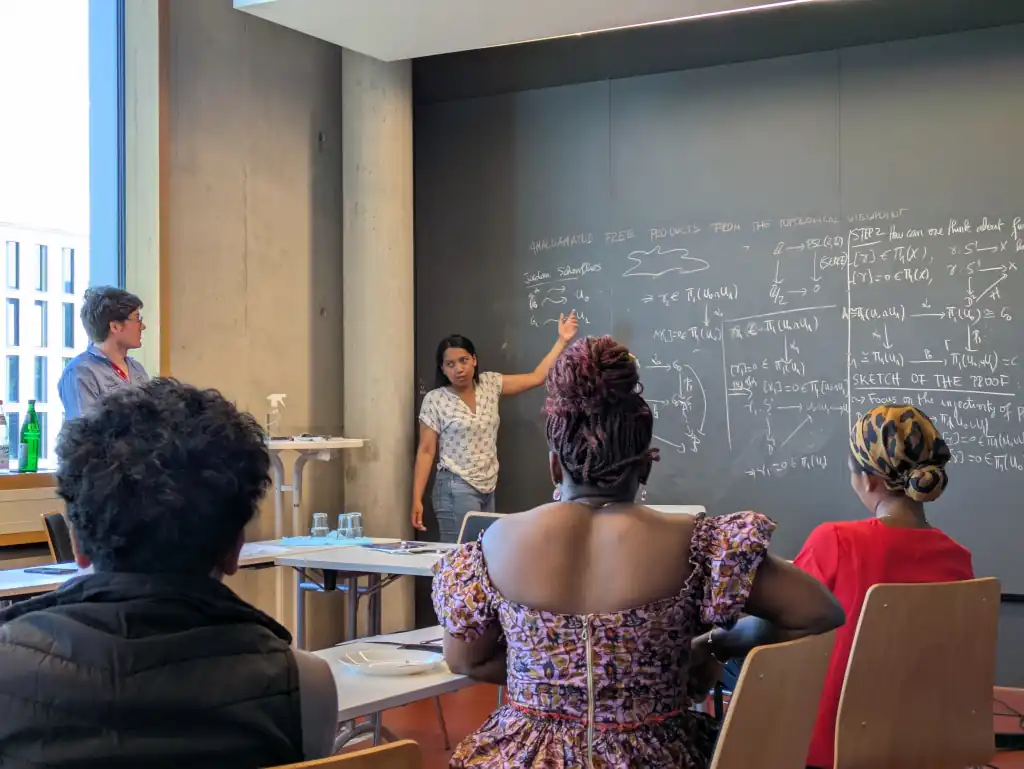
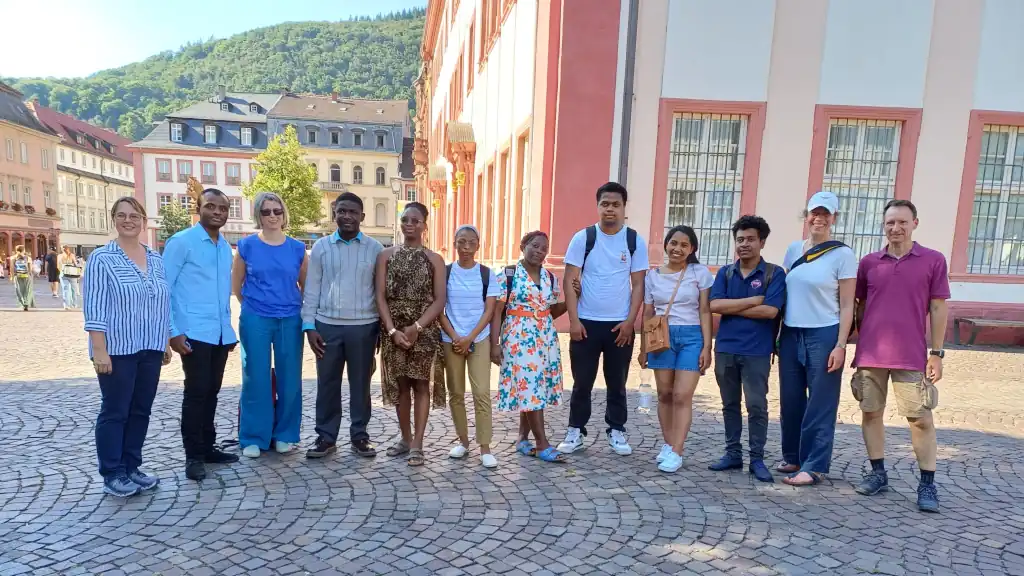
On June 31 and July 01, the STRUCTURES Cluster of Excellence had the pleasure of welcoming YAM fellows and organizers from various German clusters of excellence to this year's YAM network meeting in Heidelberg. During the meeting, which took place at the STRUCTURES “Oberstübchen”, the YAM fellows presented and discussed their research, shared experiences from their stays in Germany, and engaged in dialogue with peers and coordinators. In addition, the second day featured two talks on career opportunities for mathematicians in Germany by invited guests Dr. Helke Hillebrand (Graduate Academy Heidelberg) and Dr. Patrick Wagner (heiSKILLS Competence and Language Centre). The programme was complemented by a campus tour, a guided walk through Heidelberg's Old Town, a group dinner and several informal opportunities for networking and exchange.
The two-day meeting fostered lively discussion, providing valuable insights and new connections for both fellows and coordinators of YAM. During the final feedback session, participants shared their impressions and feedback directly with the YAM coordination team, contributing to the continuous development of the programme.
The YAM (Young African Mathematicians) Programme is a collaborative initiative between the five centres of the African Institute for Mathematical Science (AIMS – Cameroon, Senegal, Rwanda, Ghana and South Africa) and four German clusters of excellence (HCM Bonn, Mathematics Münster, MATH+ Berlin, STRUCTURES Heidelberg) that cover mathematical research. Its mission is to encourage young, talented and highly motivated graduates of the AIMS master's programme to conduct a research stay at an excellent mathematical institution in Germany. Supervised by a professor (and supported by mentors), the fellows pursue independent research and participate in a structured curriculum of courses and lectures.
More than a visiting fellowship, YAM seeks to build a strong and lasting network among young African researchers and the German mathematics community. Regular network meetings, such as the one held in Heidelberg, play a key role in fostering exchange and collaboration across institutions and continents.
STRUCTURES is proud to have been an official partner of the YAM Programme since 2023. Through its contribution to the YAM Programme, STRUCTURES aims to promote international cooperation, diversity and equal opportunities. In the first year of its contribution, STRUCTURES has hosted the YAM fellows Richarlotte Razafindravola and Olivette Tchouangnou Chuagua. In the 2024/25 period, we were happy to welcome Mina Chavelle Tchoua Tchoua, Mickaya Aimé Razanaparany, and Eunisse Nzetchuen Mangaptche. The local YAM coordination team in Heidelberg consists of Prof. Hans Knüpfer, Dr. May-Britt Becker and the STRUCTURES Office team.
Further information: