
Newsroom
Stay informed with our latest news and announcements on this page. For more in-depth content, we also encourage visitors to explore our bimonthly STRUCTURES Newsletter magazine, which features a variety of articles, interviews with members, and background information on our latest research and activities.

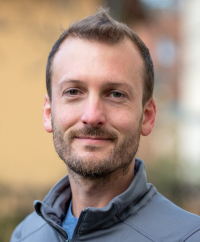
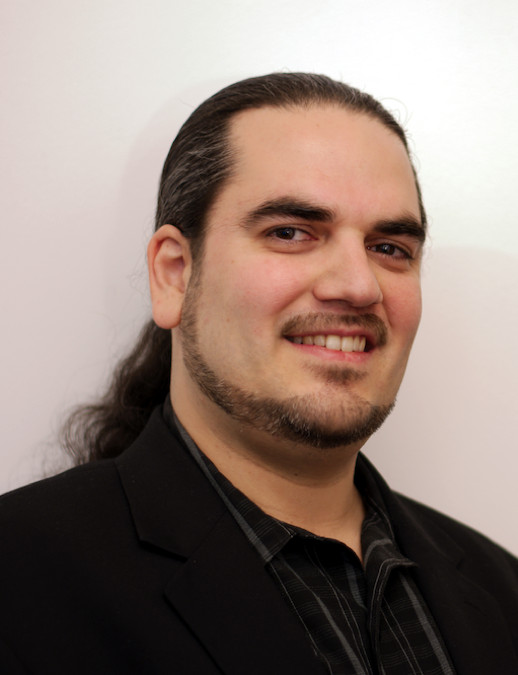 Prof. Guy Wolf (MILA / Université de Montréal, Canada, picture used with kind permission)
We are delighted to announce that Prof Guy Wolf, CIFAR AI Chair at MILA, Montreal, and Associate Professor at Université de Montréal, will be joining Heidelberg University for a research stay at the Interdisciplinary Center for Scientific Computing (IWR) and STRUCTURES in early 2024, as part of the competitive Humboldt Research Fellowship Programme.
The Humboldt Research Fellowship enables outstanding researchers to conduct their own research in collaboration with a host at a German research institution of their choice, fostering a dynamic exchange of knowledge and expertise. During his stay in Heidelberg, Prof Wolf will also hold a one-week compact course for MSc and PhD students.
Prof Wolf's research focuses at the intersection of machine learning, data science and applied mathematics. He is particularly interested in data mining methods utilizing manifold learning and deep geometric learning, as well as applications for exploratory analysis of biomedical data. His multidisciplinary approach integrates machine learning, signal processing, and applied mathematics to discover patterns, dynamics, and structures in large high-dimensional datasets.
We eagerly welcome Prof Wolf and anticipate the fruitful collaborative exchange!
Further information:
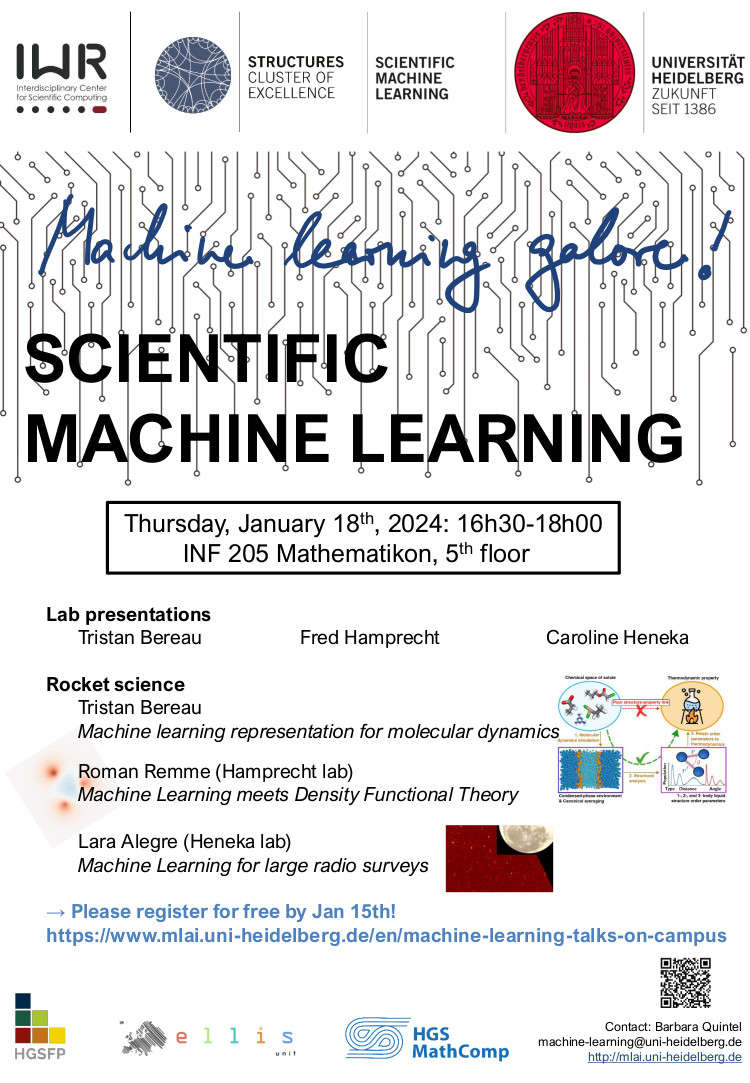 Click on the image to open the poster as PDF.
We are happy to announce the next Scientific Machine Learning event from the series “Machine Learning Galore!”, which will take place on January 18 from 4:30 to 6:00 pm in INF 205 Mathematikon (5th floor). The event will include various lab presentations and science talks:
Machine Learning galore! - Programme:
- Lab presentations:
- Tristan Bereau, Fred Hamprecht, Caroline Heneka
- Rocket Science:
- Tristan Bereau: Machine learning representation for molecular dynamics
- Roman Remme (Hamprecht lab): Machine Learning meets Density Functional Theory
- Lara Alegre (Heneka lab): Machine Learning for large radio surveys
To help plan the catering, please register for free until Jan 15 via this webpage.
Scientific Machine Learning is a joint initiative from IWR and STRUCTURES to foster interactions within and development of the local machine learning community. Its portal, http://mlai.uni-heidelberg.de summarizes the many relevant events and news from across campus that would otherwise remain scattered across single institutions or fields. The goal of the initiative aligns with the STRUCTURES Cluster of Excellence's objective of driving research into the fundamental understanding of current and future machine learning, and with IWR’s aim to leverage machine learning to enable the solution of long-standing problems in the natural and life sciences, the engineering sciences, as well as the humanities.
Further information and links:
- Scientific Machine Learning (MLAI) homepage
- Machine Learning Talks on Campus – Information service and mailing list
- Interdisciplinary Center for Scientific Computing (IWR)
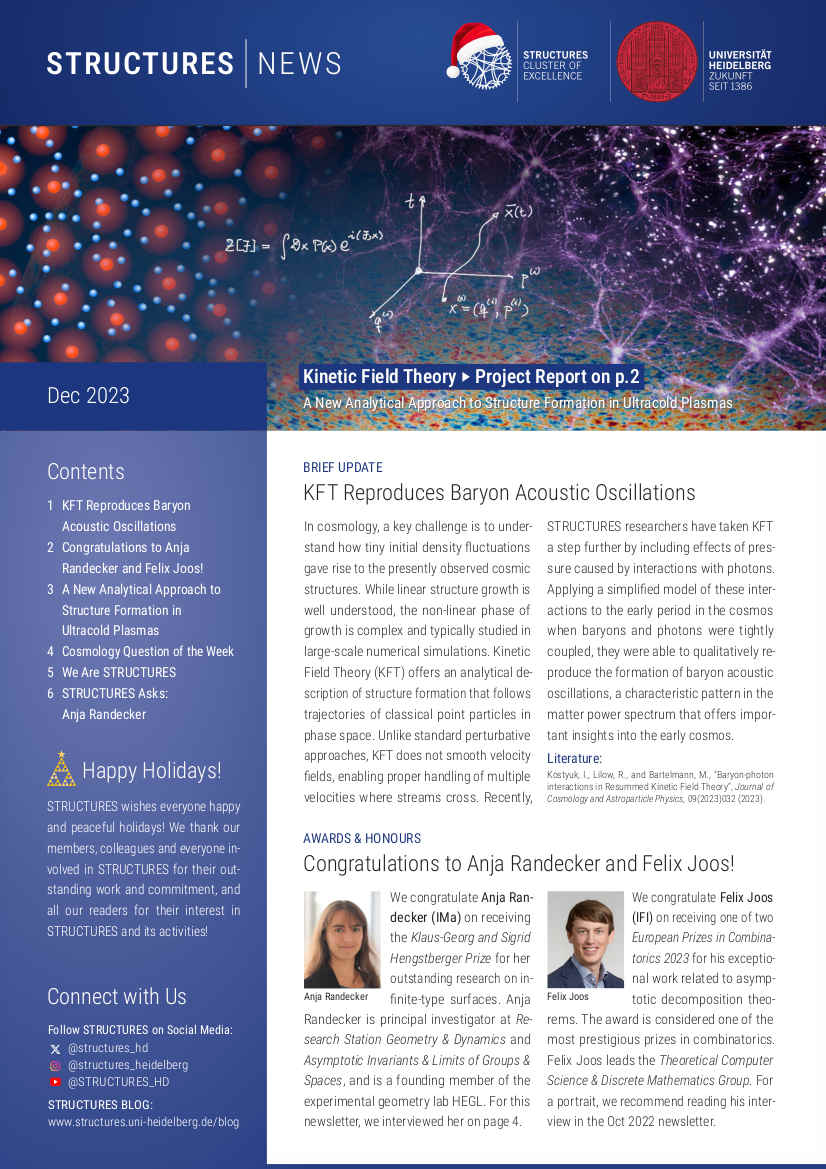 Click on the image to open the Newsletter as PDF.
We are happy to present the 14th volume of the STRUCTURES Newsletter with the following topics:
- KFT Reproduces Baryon Acoustic Oscillations
- Congratulations to Anja Randecker and Felix Joos!
- A New Analytical Approach to Structure Formation in Ultracold Plasmas
- Cosmology Question of the Week
- We Are STRUCTURES
- STRUCTURES Asks: Anja Randecker
The STRUCTURES Project Management Office is happy to answer questions and to receive feedback.
The STRUCTURES Cluster of Excellence is proud to announce that two of its members, Prof Dr Simon Anders and Dr Dylan Nelson, have been recognized as "Highly Cited Researchers" in the latest international evaluation conducted by the analytics company Clarivate.
The “Highly Cited Researchers” list includes a total of 20 disciplines from the natural, life and social sciences as well as the cross-field category, recognizing researchers with an outstanding track-record of publications across several disciplines. The latest list of highly cited researchers assessed publications between 2012 and 2022. Highly cited publications are those in the top 1% by citations in their respective field and year of publication.
Prof Dr Simon Anders (Biology/Biochemistry):
Prof Dr Simon Anders is heading the Bioinformatics tools for omics data group at BioQuant and ZMBH. Within STRUCTURES, he is part of Comprehensive Project (CP) 3: From Molecules to Cells and Tissue, and involved in Exploratory Project (EP) 9.9: Mathematical modelling and model-based data analysis of structured stem cell systems. His research involves developing computational tools for biologists to analyze and interpret high-throughput assay data, particularly in sequencing, visual exploration of large datasets, and integrating transcriptomics and proteomics in functional genomics and systems medicine.
Dr Dylan Nelson (Astrophysics):
Dr Dylan Nelson is heading the "Computational Galaxy Formation and Evolution" Emmy Noether Junior Research Group at the Institute for Theoretical Astrophysics of the Center for Astrophysics (ZAH) at Heidelberg University. Within STRUCTURES, he is involved in Comprehensive Project (CP) 1: Cosmic Structure Formation. Dylan Nelson's research focus is developing and analyzing theoretical (computational) models of galaxy formation and evolution, with an emphasis on cosmic gas. He is also a leader within the IllustrisTNG Project, and Co-PI of TNG50: next-generation large-volume cosmological magnetohydrodynamical simulations of galaxy and large-scale structure formation and of the TNG-Cluster simulation.
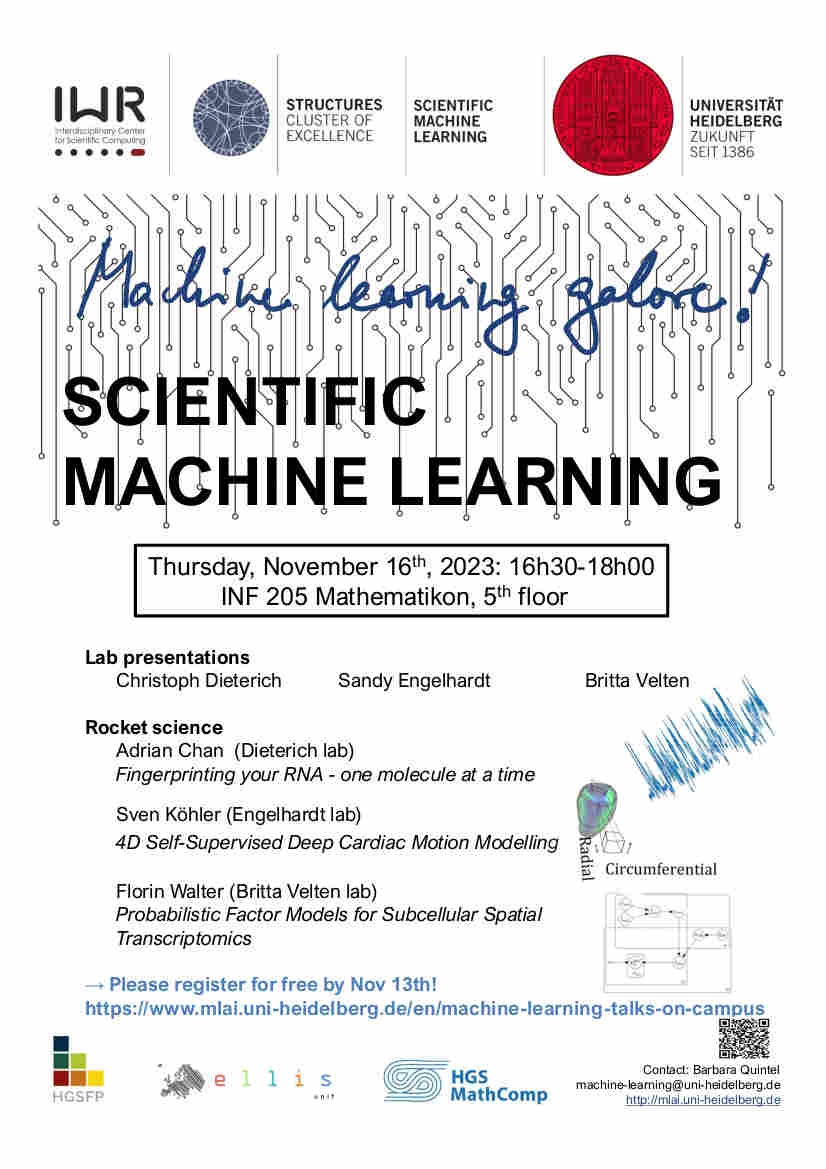 Click on the image to open the poster as PDF.
We are happy to announce the next Scientific Machine Learning event “Machine Learning Galore!”, taking place on November 16, 4:30 to 6:00 pm and featuring various lab presentations and science talks:
Machine Learning galore! - Programme:
- Lab presentations:
- Christoph Dieterich, Sandy Engelhardt, Britta Velten
- Science talks:
- Adrian Chan (Dieterich lab): Fingerprinting your RNA - one molecule at a time
- Sven Köhler (Engelhardt lab): 4D Self-Supervised Deep Cardiac Motion Modelling
- Florin Walter (Britta Velten lab): Probabilistic Factor Models for Subcellular Spatial Transcriptomics
To help plan the catering, please register for free until Nov 13 via this webpage.
Scientific Machine Learning is a joint initiative from IWR and STRUCTURES to foster interactions within and development of the local machine learning community. Its portal, http://mlai.uni-heidelberg.de summarizes the many relevant events and news from across campus that would otherwise remain scattered across single institutions or fields. The goal of the initiative aligns with the STRUCTURES Cluster of Excellence's objective of driving research into the fundamental understanding of current and future machine learning, and with IWR’s aim to leverage machine learning to enable the solution of long-standing problems in the natural and life sciences, the engineering sciences, as well as the humanities.
Further information:
- Scientific Machine Learning (MLAI) homepage
- Machine Learning Talks on Campus – Information service and mailing list
- Interdisciplinary Center for Scientific Computing (IWR)
We are happy to announce an upcoming Diversity & Awareness event with the title LGBTQ+ in Physics, presented by Wren Vetens (they/them & she/her) from the CMS collaboration. This event will take place on Thursday, October 26 at 15:00 in the Goldenbox of the PI, INF 226.
The presentation is focused on everyday challenges people of the LGBTQ+ community experience and how this influences their work life. Physics attracts a very diverse group of people and all these people have different cultural backgrounds and identities. To be able to work in such an environment, people need to feel safe and respected. At the end of the seminar we will have the possibility to reflect together on the meaning of a welcoming working place and about how awareness could be improved. Snacks and drinks will be served at the end of the event to have the possibility to continue discussing in open way.
For more information on this event, see:
https://indico.cern.ch/event/1309701/
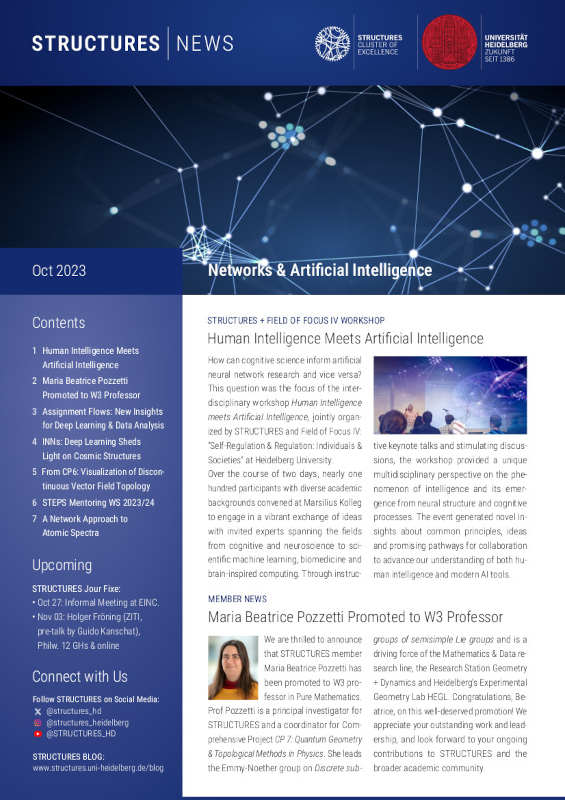 Click on the image to open the Newsletter as PDF.
We are happy to present the thirteenth volume of the STRUCTURES Newsletter with the following topics:
- Human Intelligence Meets Artificial Intelligence
- Maria Beatrice Pozzetti Promoted to W3 Professor
- Assignment Flows: New Insights for Deep Learning & Data Analysis
- Invertible Neural Networks: Deep Learning Sheds Light on Cosmic Structures
- From CP6: Visualization of Discontinuous Vector Field Topology
- STEPS Mentoring Winter Semester 2023/24
- A Network Approach to Atomic Spectra
The STRUCTURES Project Management Office is happy to answer questions and to receive feedback.