
Newsroom
Stay informed with our latest news and announcements on this page. For more in-depth content, we also encourage visitors to explore our bimonthly STRUCTURES Newsletter magazine, which features a variety of articles, interviews with members, and background information on our latest research and activities.
STRUCTURES is delighted to have hosted Oleksii Krupchytskyi from Penn State University as part of its guest programme. During his stay in Heidelberg, Krupchytskyi gave a special talk on "Bifurcations in a Free-Boundary PDE Model of Cell Motion". In the joint seminar of the groups of U. Schwarz and A. Marciniak-Czochra (Comprehensive Project 3: From Molecules to Cells and Tissue), Krupchytskyi demonstrated how to analytically obtain the transition from a super- to a subcritical bifurcation to motile solutions. This transition is caused by nonlinear diffusion of contractile myosin motors, as recently suggested and obtained numerically by the Schwarz group. The visit and seminar highlighted significant advancements in the understanding of cellular motility and the synergy between analytical and numerical approaches in biological research.
Further information:

Have you ever been in a situation where you wanted to help - but didn’t know what to do or what to say? Join us for an interactive training session to become an active bystander! The training sessions are designed to equip you with the tools and knowledge needed to intervene effectively in situations where someone may be at risk of harm or harassment. During this interactive session, you will learn practical strategies for assessing situations, de-escalating conflicts, and providing support to those in need. Experienced facilitators will guide you through real-life scenarios and provide insights on how to overcome common barriers to intervention. By becoming an active bystander, you can play a crucial role in creating safer and more inclusive spaces within our community.
The active bystander training is a joint initiative of the Collaborative Research Centre ISOQUANT and the STRUCTURES Cluster of Excellence. We will be offering tailored training sessions, acknowledging different professional contexts or campus environments and fostering a safe space where everyone can speak out and share experiences without fear.
Date: Tuesday, 28 May 2024
Time:
Session 1 (for project leaders): 09:30 - 11:00
Session 2 (for young researchers): 11:30 - 13:00
Session 3 (for young researchers): 14:00 - 15:30
All sessions will be held in English.
Location: Golden Box, Physikalisches Institut, INF 226, 69120 Heidelberg
Participation is free of charge, however, prior registration is needed as places are limited. For registration, please send an email to sfb1225@thphys.uni-heidelberg.de, stating your full name, working group/institute and the session you would like to join.
We believe that by working together and empowering each other, we can make a significant difference in promoting safety and well-being for everyone in our community. If you have any questions or require further information, please don't hesitate to contact us.
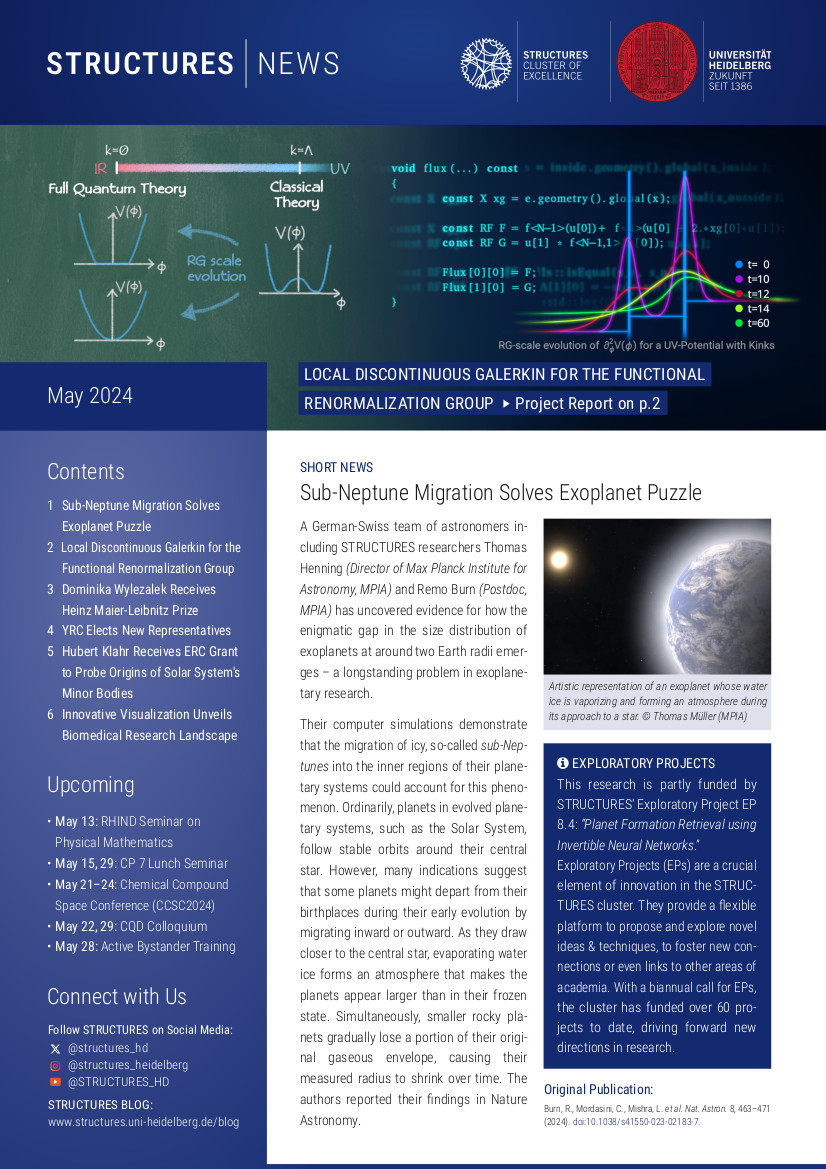 Click on the image to open the Newsletter as PDF.
 We are happy to present the 16th volume of the STRUCTURES Newsletter, featuring research news, background articles and interviews. The topics of this edition are:
- Sub-Neptune Migration Solves Exoplanet Puzzle
- Local Discontinuous Galerkin for the Functional Renormalization Group
- Dominika Wylezalek Receives Heinz Maier-Leibnitz Prize
- YRC Elects New Representatives
- Hubert Klahr Receives ERC Grant to Probe Origins of Solar System's Minor Bodies
- Innovative Visualization Unveils Biomedical Research Landscape
The STRUCTURES Project Management Office is happy to answer questions.
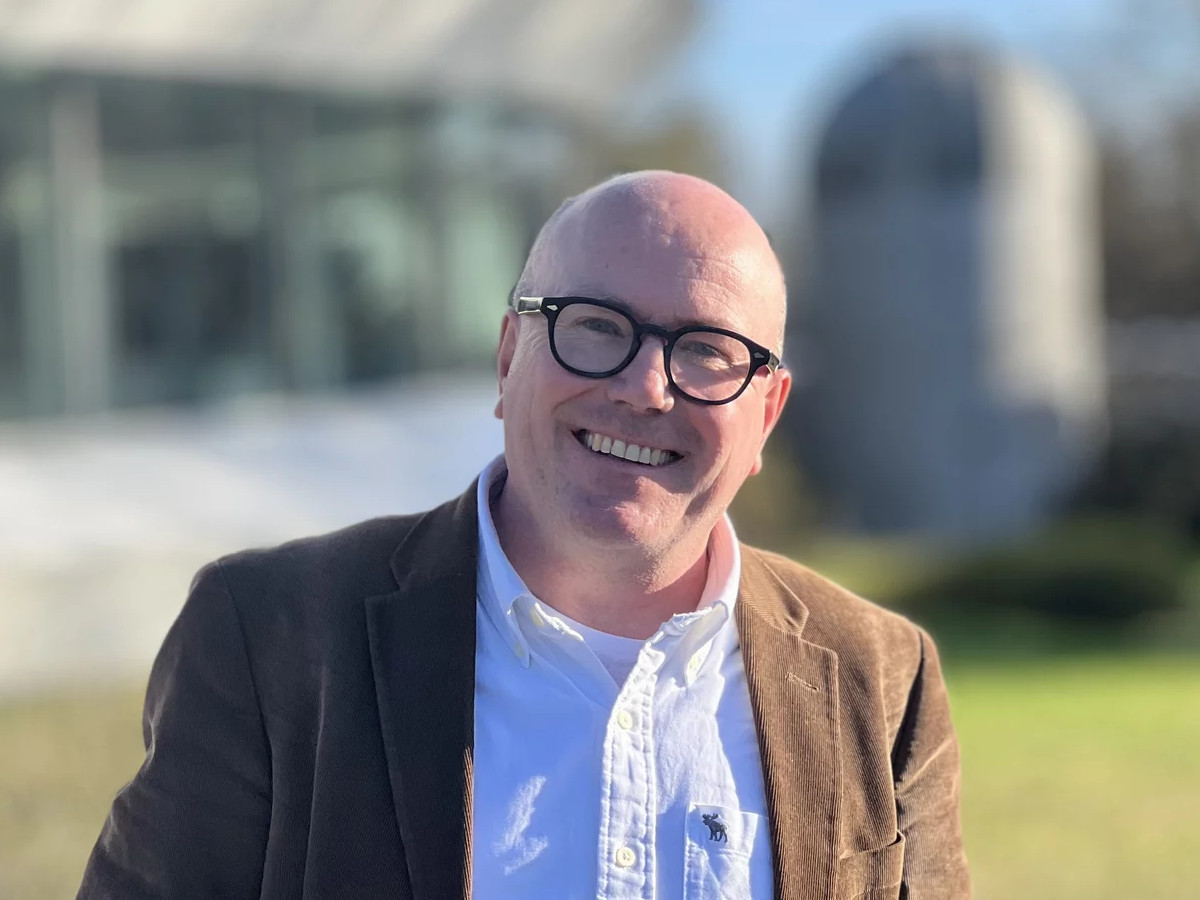 Hubert Klahr (© Oliver Völkel/MPIA)
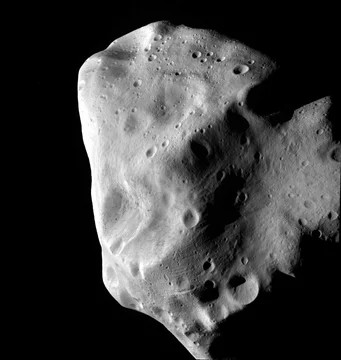 Main belt asteroid 21 Lutetia (© ESA 2010 MPS for OSIRIS Team MPS/UPD/LAM/IAA/RSSD/INTA/UPM/DASP/IDA )
We congratulate our member Hubert Klahr, head of the theory group in the Planet & Star Formation department at Max Planck Institute for Astronomy (MPIA) and principal investigator of STRUCTURES' Comprehensive Project 2 (From Dust to Planets), on securing one of the European Research Council's prestigious Advanced Grants. The prize, endowed with 2.49 million euros funding over the next five years, will support his pioneering project “Turbulence, Pebbles, and Planetesimals: Origin of Minor Bodies in the Solar System (TiPPi).”
The TiPPi project aims to unravel the mysteries surrounding the formation of minor celestial bodies, such as asteroids, comets and dwarf planets in the solar system. Most of these smaller bodies are presumed to be remnants of planetary building blocks known as planetesimals, typically ranging from a few dozen kilometres in diameter. These planetesimals formed through collisions and the accumulation of centimetre-sized chunks, referred to as 'pebbles'. Pebbles typically measure in the centimetre to decimetre range, while planetesimals range from 10 to 100 kilometres in diameter. However, “despite their immense importance for the early history of the Solar System and therefore also for the formation of the Earth, we still don’t know where and when they formed in the ‘solar nebula’,” says Hubert Klahr. “We will therefore develop an innovative numerical experiment that combines three phases of planetesimal formation. We will use special methods to study turbulence, apply machine learning to analyse pebble sizes and dust opacities, and investigate the elasticity and porosity evolution of the forming planetesimals.” The research not only promises insights into the early history of our solar system but also offers connections to the diversity of exoplanetary systems. The techniques and tools developed will be beneficial to the broader scientific community.
The ERC Advanced Grant is one of the most esteemed and competitive research grants in Europe, awarded to exceptional senior researchers with the potential to catalyze significant scientific advancements. Out of 1829 applications, only 255 outstanding research leaders in Europe are selected for this prestigious honour.
Further information:
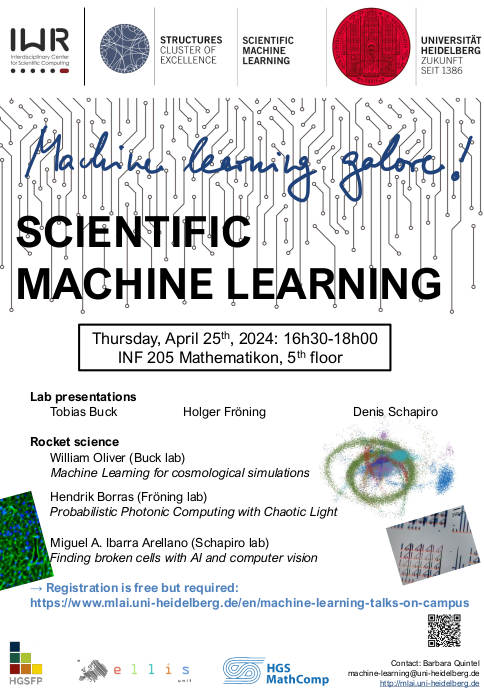 Click on the image to open the poster as PDF.
We are happy to announce the next Scientific Machine Learning event from the series “Machine Learning Galore!”, taking place on April 25, 4:30 to 6:00 pm at INF 205 Mathematikon (5th floor). The event will include various lab presentations and science talks:
Machine Learning galore! - Programme:
- Lab presentations:
- Tobias Buck
- Holger Fröning
- Denis Schapiro
- Rocket Science:
- William Oliver (Buck lab): Machine Learning for cosmological simulations
- Hendrik Borras (Fröning lab): Probabilistic Photonic Computing with Chaotic Light
- Miguel A. Ibarra Arellano (Schapiro lab): Finding broken cells with AI and computer vision
In order to participate, please register for free at https://www.mlai.uni-heidelberg.de/en/machine-learning-talks-on-campus.
Scientific Machine Learning is a joint initiative from IWR and STRUCTURES to foster interactions within and development of the local machine learning community. Its portal, http://mlai.uni-heidelberg.de summarizes the many relevant events and news from across campus that would otherwise remain scattered across single institutions or fields. The goal of the initiative aligns with the STRUCTURES Cluster of Excellence's objective of driving research into the fundamental understanding of current and future machine learning, and with IWR’s aim to leverage machine learning to enable the solution of long-standing problems in the natural and life sciences, the engineering sciences, as well as the humanities.
Further information:
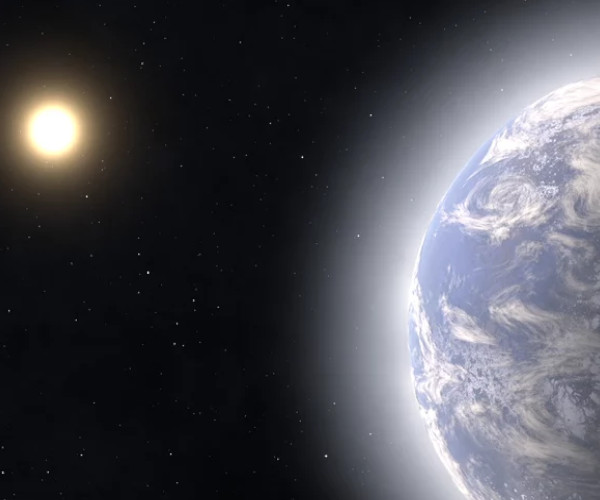 Artistic representation of an exoplanet whose water ice is vaporizing and forming an atmosphere during its approach to a star. © Thomas Müller (MPIA)
 Simulations provide a potential explanation for the mysterious gap in the size distribution of super-Earths.
Astronomers from Germany and Switzerland, including STRUCTURES member Thomas Henning (Director of Max Planck Institute for Astronomy, MPIA) and YRC Postdoc Remo Burn (MPIA), have uncovered evidence of how the enigmatic gap in the size distribution of exoplanets at around two Earth radii emerges – a longstanding problem in exoplanetary research. Their computer simulations demonstrate that the migration of icy, so-called sub-Neptunes into the inner regions of their planetary systems could account for this phenomenon. Ordinarily, planets in evolved planetary systems, such as the Solar System, follow stable orbits around their central star. However, many indications suggest that some planets might depart from their birthplaces during their early evolution by migrating inward or outward. As they draw closer to the central star, evaporating water ice forms an atmosphere that makes the planets appear larger than in their frozen state. Simultaneously, smaller rocky planets gradually lose a portion of their original gaseous envelope, causing their measured radius to shrink over time. The authors reported their findings in an article published in Nature Astronomy. (Original Press Release by MPIA)
Further information:

STRUCTURES Members Share Insights on AI Impact, Deception & Truth Quest in RUPERTO CAROLA Magazine
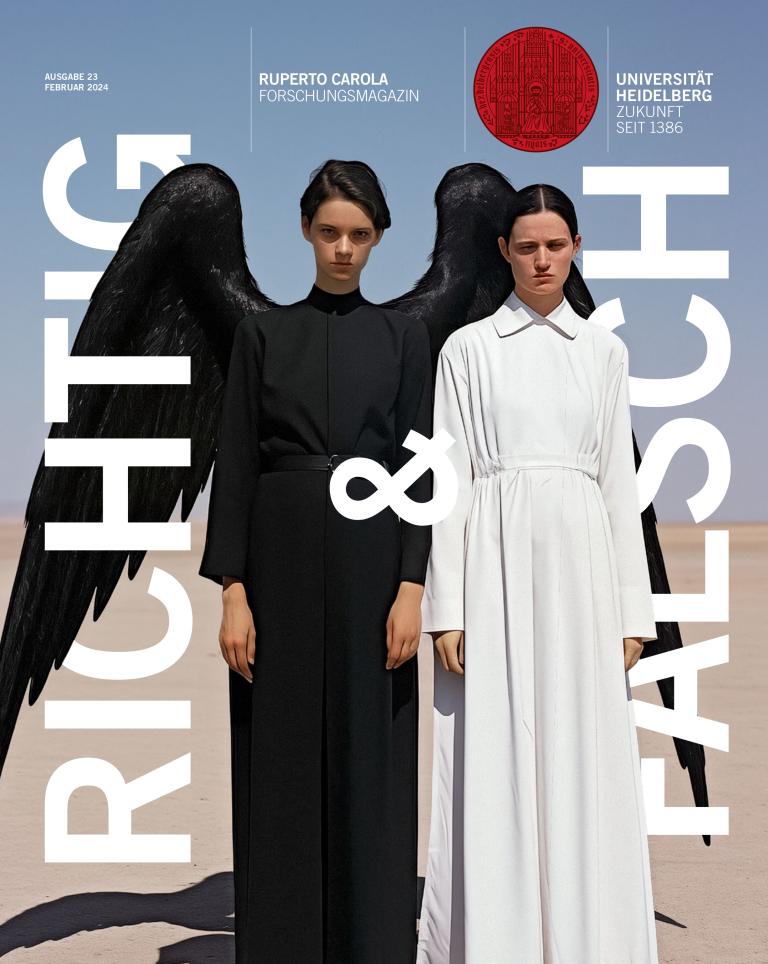
(Source: Heidelberg University Publishing)
The latest issue of Ruperto Carola, Heidelberg University's research magazine, explores the pressing question of artificial intelligence's impact on society and the broader themes of “Right & Wrong.” From historical deceptions to modern dilemmas like fake news and conspiracy theories, this issue presents insightful perspectives contributed by a range of researchers, including STRUCTURES members Georgia Koppe, Manfred Salmhofer, and Fred Hamprecht.
In a collaborative article, computational psychiatrist Georgia Koppe from STRUCTURES, alongside her colleagues Martin Fungisai Gerchen (Biological Psychology) and Andreas Meyer-Lindenberg (Psychiatry and Psychotherapy), intricately examine the interplay between various forms of heterodox beliefs, with a focus on conspiracy theories. They shed light on their characteristics, prevalence, and potential correlations with mental health factors. In the same issue, Fred Hamprecht from STRUCTURES (Machine Learning and Artificial Intelligence) engages in a conversation with ChatGPT on AI ethics. In the interview “Proofs of God and Flight Paths – The Search for Universal Truths,” mathematical physicist and speaker of the STRUCTURES Cluster, Manfred Salmhofer and theologian Prof. Dr. Friederike Nüssel discuss the subjects of knowledge creation and the concept of “right”, “wrong” and universal truths in science.
The Rupert Carola research magazine appears twice a year, mainly in German with English abstracts, and addresses all members of the university, its partners in academia, politics, business and society, and, in particular, alumni, friends and an interested public in Germany and abroad. All editions are accessible via the open access publisher Heidelberg University Publishing (heiUP).
Further information: